Yala National Park · Sri Lanka
About Yala Ethical Safari
A small, personally run safari business specialising in Yala National Park's Blocks 5 and 6.
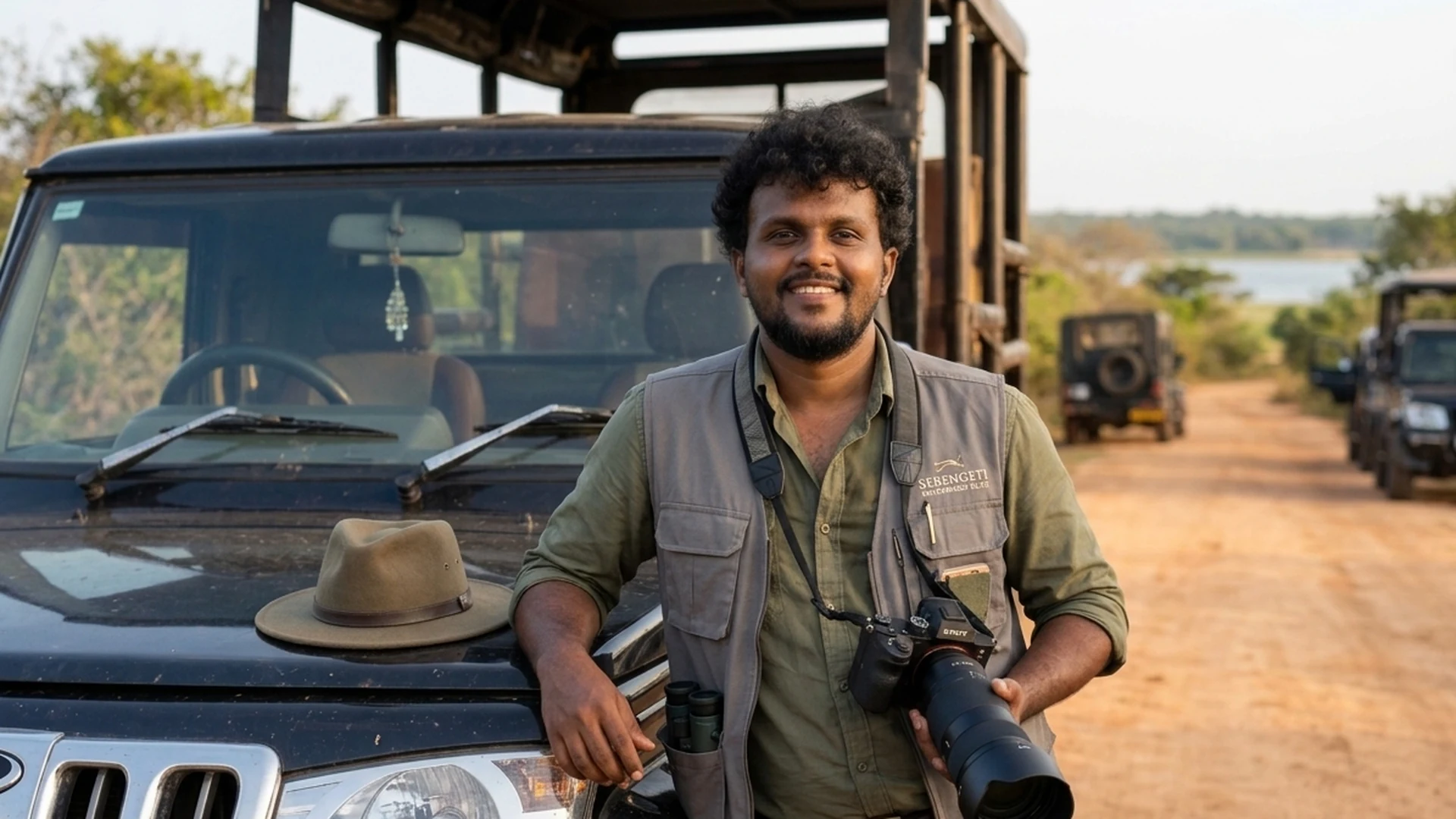
The Naturalist Guide and photographer behind Yala Ethical Safari — Prasanna Gamage.
What we are
Why Yala Ethical Safari? What "ethical" means to us
When most people talk about Yala National Park, they usually talk about Block 1, often without realising that Yala is a much larger ecosystem with several different blocks, each offering a different experience.
Block 1 is the most famous part of Yala, and for good reason. It has one of the highest leopard densities in the world, so if seeing a leopard is your main priority, Block 1 can give you a better chance of seeing one.
But there is another side to it. During busy periods, many jeeps can end up sharing the same roads, especially when a leopard is spotted. It can sometimes feel more like following a queue of vehicles than quietly exploring a national park.
Blocks 5 and 6 are very different.
There are far fewer jeeps, so the pace is slower and much more peaceful. You spend more time watching wildlife naturally, without crowds of vehicles around you.
Leopard sightings are generally less frequent than in Block 1, and we're always honest about that. But these blocks still have leopards, elephants, sloth bears, crocodiles, birds, and plenty of other wildlife.
And that's really why we chose them.
We're not trying to offer every possible type of Yala safari. We chose the areas that fit the kind of experience we want to give our guests.
If seeing a leopard is your number one priority, Block 1 may be a better fit for you, and we might not be the right choice.
If you're looking for a quieter safari where you can enjoy nature without the crowds, Block 5 and Block 6 are exactly why we started this business.
When people hear the words "ethical safari", they may wonder what that actually means once they're inside the park. Some imagine a strict set of rules, while others picture a jeep that barely moves, staying in one place for hours. For us, it's neither of those things. It's more about how we approach the park, how we make decisions during the day and what we believe makes a safari worth having in the first place.
To explain this, it helps to think about how a safari can unfold. You enter the park hoping to see wildlife, and naturally, there are certain animals you've been looking forward to. If a leopard appears, everyone gets excited, and rightly so. But once the sighting is over, the attention quickly shifts to what might come next.
Elephant, tick. Leopard, tick. Sloth bear, tick. What's next? Let's move. Drive, drive, drive. Perhaps there's another leopard somewhere else, so we hurry towards the next sighting. Before long, the whole day can turn into a race to find as many animals as possible, with very little time to stop and appreciate what's happening around us.
There's nothing wrong with wanting to see these animals. We love seeing them too, and we understand the excitement that comes with a good sighting. The difficulty begins when finding the next animal becomes the only thing that matters. When all our attention is focused on what might be around the next corner, we can easily miss what's happening right in front of us.
That's why we prefer to approach the day a little differently. Rather than measuring a safari only by the number of animals we find, we try to make time to understand what we're seeing. Sometimes that means staying a little longer with an animal and observing its behaviour. At other times, something much smaller catches our attention.
It might be a bird that most vehicles would drive past without a second look. If there's something interesting happening, we can stop and watch for a while. Or we might come across a group of langurs feeding, playing or suddenly becoming alert because they've noticed something nearby. By spending a little time observing them, we can begin to understand what they're doing rather than simply identifying the species and moving on.
These moments might not be the reason you came to Yala, but they can add something unexpected to the day. The longer you watch an animal, the more you begin to notice that it's not simply sitting there waiting to be seen. It's busy with its own life, finding food, communicating, staying alert to danger and responding to everything happening around it. Even a familiar animal can become much more interesting when you take the time to understand its behaviour.
And once you begin paying attention to the animals, you naturally start noticing the places they live in. The landscape is an important part of the story, too. When driving through Yala, it's easy to keep looking at the bushes on either side of the road, hoping to spot some movement. But the trees, the water, the vegetation and the way one habitat changes into another all help explain why different animals use different parts of the park.
An open area around a reservoir, for example, offers different opportunities for observing wildlife from a stretch of thicker woodland. The surroundings influence where animals find food, where they seek shelter and how they move through the landscape. Understanding these differences helps us see the park as more than a series of separate wildlife sightings. We begin to understand how the different parts connect and why each area has its own character.
Of course, this doesn't mean we stay in one place all day or refuse to move when a good opportunity comes along. If there's a good chance of seeing a leopard nearby, we'll go and try. We understand why guests are excited about leopards, and we enjoy those encounters ourselves. Sometimes conditions change, too, and exploring another area is simply the sensible thing to do.
What matters is the reason behind the decision. We don't want to keep driving just because we feel we must find another major sighting. Sometimes it's worth waiting a little longer to see what happens. At other times, moving on gives us a better opportunity to explore. Part of guiding is learning to recognise the difference and making decisions according to what's happening in the park. No two days are exactly the same, so the approach has to remain flexible.
The people in the jeep matter just as much. Every guest arrives with different interests, and these can influence how we experience the park together. Someone interested in wildlife photography may want to pay closer attention to the light, an animal's behaviour and the position of the vehicle. Another guest might be fascinated by birds, while someone else may simply want to understand more about the animals they encounter.
That's why we like to learn about your interests before the safari and remain open to whatever catches your attention once we're inside the park. We can't arrange wildlife encounters in advance, and we can't predict exactly how the day will unfold. What we can do is listen to what you're interested in, explain what we know and make thoughtful decisions as the safari progresses.
A leopard is part of the ecosystem, just as an elephant is, or a small bird, an insect or an old tree beside the water. These things don't exist independently of one another. The habitats, the food, the water and the living things that depend on them are all connected. Those connections help shape how wildlife lives and moves through the park.
Once you begin noticing these relationships, you may find yourself looking at the landscape differently. A bird feeding near the water, an animal moving through the vegetation or a change in the surroundings can lead to questions you might not have thought to ask when the day began. The safari becomes not only about what you see, but also about understanding a little more of what is happening around you.
For us, that's one of the most rewarding parts of guiding. We want you to enjoy the wildlife you came hoping to see, but we'd also like you to leave with a better understanding of the place you've spent time exploring. Even on a day when a leopard doesn't appear, there can still be plenty to observe, learn about and appreciate.
So, what does the name Yala Ethical Safari mean to us? It isn't a promise that we'll always move slowly, never change direction or follow the same routine on every safari. It's about approaching each day thoughtfully, respecting that wildlife lives according to its own rhythms and helping guests see the bigger picture rather than measuring everything by one sighting.
Ultimately, we want to share Yala in a way that reflects how we enjoy exploring it ourselves. Come looking forward to the wildlife, by all means. We simply hope you'll leave having understood and noticed a little more than you expected.
The operation
A small business, run personally
Yala Ethical Safari is a small business that I manage personally. I'm not running a large company with separate departments handling enquiries, planning and guiding.
I'm the person who answers your messages, discusses your plans, explains the differences between the blocks and helps you decide whether this kind of safari suits you. I'm also the naturalist guide and wildlife photographer behind the business.
I prefer working this way because it allows me to understand what each visitor is looking for before recommending an option. Someone interested in wildlife photography may have different expectations from a family visiting Yala for the first time. Someone hoping to see a leopard may need different advice from someone who wants to explore the park at a slower pace.
Those differences matter. I don't want to simply send you a price and ask you to book without first helping you understand what you're choosing.
I also don't do every practical part of the operation alone. I have two trusted drivers who work for me and help with the transport side of the business. They are people I know and rely on, rather than drivers randomly arranged for each booking.
Keeping the business small allows me to remain personally involved in the planning and guiding while my drivers help with transport arrangements when needed. It also means I have to be realistic about availability and what I can take on.
I'd rather you know exactly who you're dealing with and how the operation works than make the business sound bigger than it is.
Background
Who I am, beyond the safari
I'm Prasanna Gamage, a naturalist guide and wildlife photographer from southern Sri Lanka. Although my work today revolves around wildlife, my original background was in Information Technology, and I spent some time working in software development before finding my way into this field.
My interest in wildlife didn't begin when I started working in safaris. I've always liked animals, especially elephants, and I've loved photography for as long as I can remember. As a child, I enjoyed watching wildlife documentaries and learning about animals and their behaviour. Growing up around Udawalawe, nature, wildlife and elephants were already familiar parts of my life. They weren't something I discovered later or had to travel far to experience. They were part of the environment I grew up in, and in many ways, they had already shaped my interests without me really thinking about it.
After studying Information Technology, I moved to Colombo and started working in software development. I was building a career in a completely different field, spending most of my working hours indoors, in front of a computer. There was nothing wrong with the work itself, but as time went on, I began to miss something that had always been important to me. I missed being outdoors, spending time in nature and having the freedom to explore my interest in wildlife and photography.
Eventually, I decided to return to my hometown. Financially, it wasn't necessarily the better choice. The pay was lower, and there were fewer career opportunities than in Colombo. But being back home meant I could spend more time doing the things I had been missing. With Udawalawe nearby, I had the opportunity to visit the park more often, take my camera (smartphone at the time) with me and spend time observing wildlife. What had always been an interest could now become a much bigger part of my everyday life.
At first, I was simply enjoying photography and learning through the time I spent in the field. I wasn't planning to leave software development for a career in wildlife, and I had no idea that those visits would eventually lead me into safari guiding.
Around the same time, I was sharing travel advice and information about Sri Lanka's national parks in Facebook groups. People would ask questions about visiting these areas, and I would help them with what I knew. Eventually, someone who had read my posts contacted me and asked if I could organise a safari for him.
I agreed because I knew the area and had contacts who could help arrange it. He loved and enjoyed the experience and later recommended me to his friends and family. More enquiries followed, and gradually, organising safaris became regular work. What had started as a personal interest in wildlife and photography was turning into something I could build a career around.
As my work developed, I began exploring other parts of Sri Lanka's national parks, including Yala. Spending more time in different areas helped me understand how much the safari experience can change depending on the habitat, the wildlife present and the number of vehicles visiting. My growing interest in Yala's Blocks 5 and 6 eventually led me to focus my work there.
Photography still plays an important part in how I approach wildlife today. When you're trying to photograph a wild animal, finding it is only the beginning. The light might not be right, the animal may move away, or it might disappear into the vegetation before you have time to react. You begin paying attention to its movements, the surroundings and the conditions that influence what happens next.
Sometimes moving to another location makes sense. At other times, staying where you are gives you a better opportunity to observe what happens.
Spending time this way has influenced how I guide. For visitors interested in wildlife photography, I can also help with understanding light, positioning and animal behaviour. But you don't need to be a photographer to enjoy the experience. My aim is to help you understand what we're seeing, explain what I can and make the most of the time we have in the park.
The decision
Why I focus on Blocks 5 and 6
Having spent time guiding in different areas, I eventually decided that I wanted Yala Ethical Safari to concentrate exclusively on Blocks 5 and 6.
This wasn't because I believe these blocks are better than every other part of Yala. They have their own strengths, but they also have limitations that visitors should understand.
Block 1 generally offers a better chance of seeing a leopard. Blocks 5 and 6 receive fewer safari vehicles on many days, which can allow for a different pace and more time to explore the surrounding landscape. However, a quieter safari doesn't guarantee better wildlife sightings, and there will be days when we don't encounter the animals we hoped to see.
For me, the decision came down to the kind of experience I wanted to offer and the expectations I wanted visitors to have before booking.
I didn't want to promote Blocks 5 and 6 as though they could provide everything Block 1 offers, only without the crowds. That wouldn't be an honest comparison. The leopard-sighting chances are different, and visitors should be able to choose with that information in mind.
Instead, I wanted to focus on what these areas can offer in their own right. They provide opportunities to explore different habitats, observe wildlife and spend time in parts of Yala that generally receive less safari traffic.
Some days may bring interesting encounters with elephants or other wildlife. On other days, the experience may be more about exploring the landscape and understanding the environment. No particular sighting can be guaranteed, and I don't want to suggest otherwise.
If seeing a leopard is your main priority, I would encourage you to consider Block 1. If elephants are what you'd most like to see, Udawalawe may be a better choice.
But if you're interested in exploring a less-visited part of Yala and learning about its wildlife without measuring the entire experience by one sighting, Blocks 5 and 6 may be right for you.
That is the focus of Yala Ethical Safari, and it is the reason I chose to build the business around these two blocks rather than trying to suit every possible safari preference.
Before you book
What you can expect when travelling with me
When you book a safari with Yala Ethical Safari, I want you to understand what you're choosing before you arrive.
We'll discuss your interests, the time you have available and what you hope to experience. I'll explain the differences between Blocks 5 and 6, the limitations regarding leopard sightings and any practical details you need to know.
Once we're in the park, the safari will depend on the conditions and the wildlife we encounter. Sometimes we may find an animal worth spending time with. At other times, it may make more sense to explore another area or look for different wildlife.
I don't promise particular animals because I cannot control what appears during a safari. What I can do is use my experience to make informed decisions, share what I know and help you understand the park as we explore it.
I also want you to feel comfortable asking questions. Whether you're interested in animal behaviour, photography, the habitats of Yala or simply how the safari works, I'm happy to explain things along the way.
For me, the experience begins before we enter the park. It starts with making sure you have a realistic understanding of what you're booking and whether it matches what you want from your visit.
Before you decide
I know these blocks won't be the right choice for everyone. If you're looking for the highest possible chance of seeing a leopard, Block 1 generally offers better opportunities. If elephants are your main priority, another park may suit your plans better.
But if you'd like to explore a less-visited part of Yala, learn about its wildlife and spend time observing what happens naturally, I'd be happy to help you decide whether Blocks 5 and 6 are suitable for you.
You don't need to know everything about wildlife before arriving. You only need a genuine interest in exploring the park and an understanding that wild animals will always do things on their own terms.
If, after learning about the differences, you feel this is the kind of safari you're looking for, I'd be happy to hear from you.
Get in touch
Come and see it for yourself.
I'm easy to reach on WhatsApp. Tell me your dates, where you're staying, and what you're hoping for. I'll be honest with you about what's possible and we can take it from there.
No booking fee · We reply personally